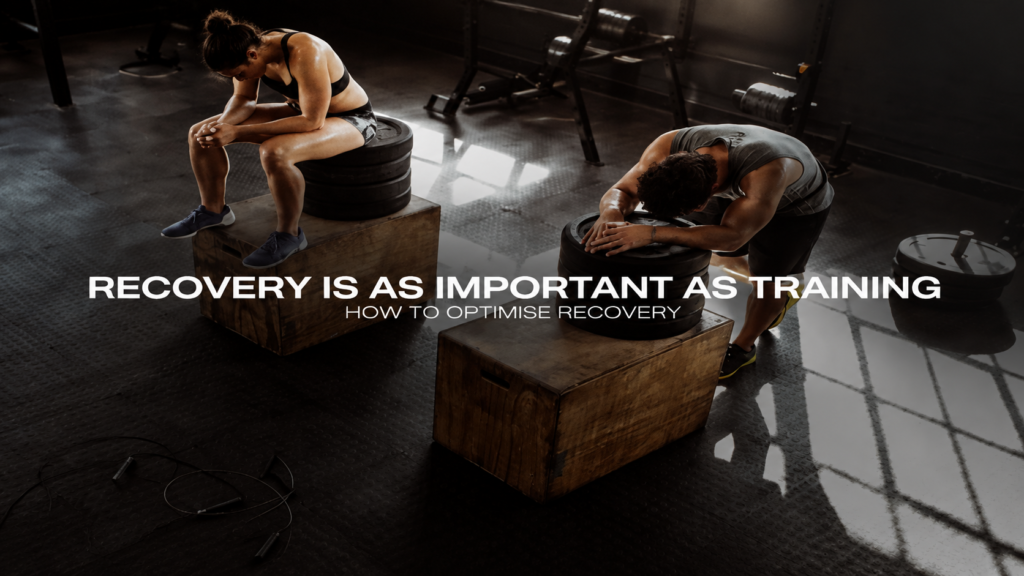
For years, fitness has centred on one question — how hard can you train. A better question is catching up fast: how well are you recovering.
Exercise places-controlled stress on the body. Muscles are challenged, energy stores are drawn down, and the body responds by repairing and adapting. But those adaptations don’t happen simply because you exercised — they happen when the body gets adequate time and support to recover. That makes recovery more than a day off. It’s an essential, active phase of the training cycle.
Recovery Is Where Adaptation Happens
After exercise, the body works to restore energy, repair tissue, and return to balance — a process that draws on sleep, nutrition, hydration, circulation, and nervous-system recovery all at once. When training consistently outpaces recovery, fatigue accumulates: performance plateaus, sleep quality drops, and the body struggles to keep up with repeated physical stress. The goal isn’t to train less. It’s to balance the equation:
Exercise → Stress → Recovery → Adaptation → Improved Capacity
And recovery doesn’t look the same for everyone. Training intensity, age, sleep quality, nutrition, lifestyle stress, and individual health goals all shape what a given body actually needs.
“Advanced therapies that support recovery”
No single therapy replaces sleep, nutrition, or appropriate training — but a growing body of research suggests several modalities can meaningfully support the body’s recovery response when layered onto those fundamentals.
Red light therapy.
Also called photo biomodulation, this uses specific wavelengths of red and near-infrared light to stimulate mitochondrial activity in cells. A review spanning 46 studies and over 1,000 participants found it can reduce exercise-induced muscle damage and inflammation, and a 2014 randomized trial found a single session eased soreness and preserved strength for up to 96 hours post-exercise.
PEMF.
Pulsed Electromagnetic Field therapy uses low-level electromagnetic pulses to support cell activity and circulation. It’s actually well-established for one thing — bone healing. It’s been FDA-cleared for fracture recovery since 1979, and it’s also backed by research for easing joint pain.
Cold plunge.
Cold-water immersion triggers vasoconstriction, blunts inflammatory signalling, and shifts nervous-system activity. Meta-analyses link short immersions at 10–15°C to measurably lower muscle soreness for up to four days post-exercise — though because cold is itself a stressor, timing and dose matter, and overuse may blunt strength adaptations.
Infrared sauna.
Heat exposure raises core temperature and drives cardiovascular and relaxation responses comparable, in one Mayo Clinic analysis, to a moderate-paced walk. A landmark 20-year Finnish cohort of over 2,000 men linked frequent sauna use to substantially lower cardiovascular mortality, and later trials tie regular sessions to measurable drops in blood pressure.
IV wellness drips.
Hydration and adequate nutrition remain the foundation of recovery for almost everyone, and food and oral fluids are the right starting point for most people. Intravenous therapy can deliver fluids and select nutrients directly into circulation when clinically appropriate.
CAROL Bike.
Recovery doesn’t mean avoiding exercise — the right stimulus is still essential. CAROL Bike applies AI-guided, high-intensity interval principles to deliver a cardiovascular and metabolic training effect in a few short, efficient sessions: the training half of the stress-and-recovery equation.
Recovery Isn’t About Doing More
More workouts, more intensity, more hours — it’s easy to think that’s the key to progress. But training alone isn’t what makes you stronger. It’s training followed by proper recovery. Push your body, then give it time to catch up. That’s when real progress happens. So, recovery isn’t something extra — it’s just as important as the workout itself.
A More Personalised Approach
There is no universal recovery protocol. What works well for one person may not work at all for another — it depends on how you train, how you sleep, and what your body is dealing with day to day. So instead of asking “which recovery therapy should I try,” a better question is: “what does my body actually need, and which approach fits my goals?”
At Northstar, recovery is approached through a combination of health assessment, biomarkers, lifestyle factors, exercise, and targeted wellness modalities — because longevity isn’t just about how much you can push your body. It’s about how intelligently you train, recover, and adapt.